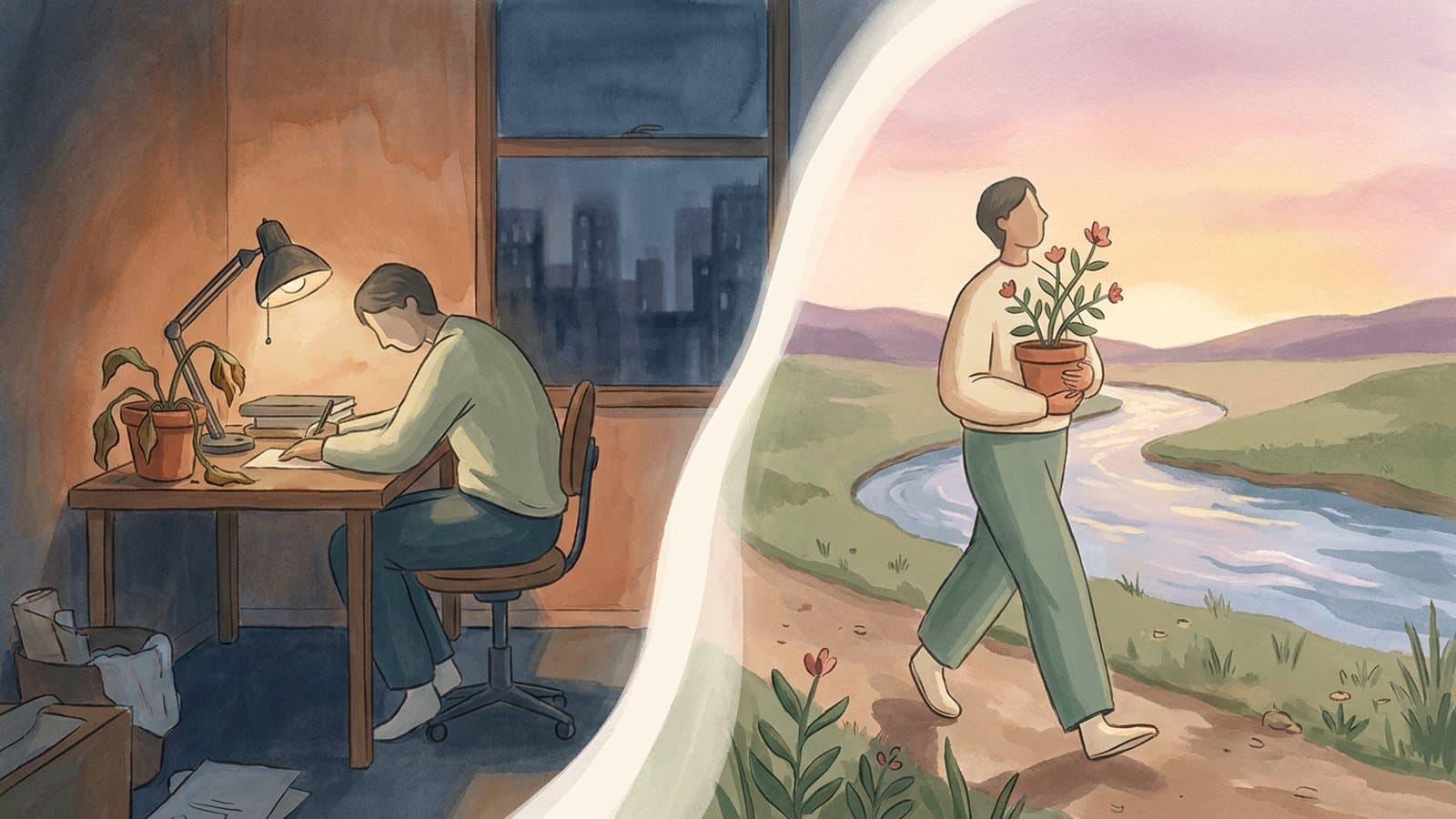
Sunday evening comes and your chest tightens at the thought of Monday. Tasks you used to take on gladly, you now just want to get through. You come back from a long weekend and within half a day you feel hollowed out again. This may be more than "a busy patch". It may be burnout telling you that, for a long time now, you have been giving out more than you get back.
This article looks at what burnout is, how it differs from ordinary tiredness and from depression, and where recovery can begin.
What burnout is (and why it is not weakness)
In the 11th revision of its International Classification of Diseases (ICD-11), the World Health Organization describes burnout as "a syndrome conceptualised as resulting from chronic workplace stress that has not been successfully managed". It is classed as an occupational phenomenon, not as a mental disorder or medical diagnosis.
The key words are work and chronic. Burnout is about your relationship with your job, not something you can explain away with "you just can't handle pressure".
The idea goes back to the mid-1970s, when Herbert Freudenberger described volunteers at New York free clinics who became exhausted, cynical and inefficient after months of overwork. The researcher Christina Maslach later organised burnout into three core dimensions, which remain the standard definition today:
- Exhaustion: your physical and emotional energy is drained, and rest does not refill it.
- Distance or cynicism: you feel colder towards your work, colleagues or clients, and want to keep them at arm's length.
- Reduced efficacy: you feel you are not doing well, or that what you do does not matter.
Burnout rarely appears overnight. Long-term studies describe a typical path: first you push hard to keep up with heavy demands and exhaustion slowly builds; as the drain becomes chronic, distancing becomes a psychological buffer; only later does a sense of ineffectiveness set in, as confidence and concentration wear down.
Common signs: body, mind and mood
The signs are often scattered across daily life and easy to dismiss as "just busy". Research reviews describe several common patterns.
Body
- Persistent fatigue: feeling drained even after a night's sleep or a holiday. Exhaustion is usually the earliest and most noticeable feature.
- Headaches, stomach upsets and poor sleep often show up alongside burnout in the general population.
Mind
- Trouble concentrating, memory slips and slower decision-making. In one study these cognitive changes were among the strongest predictors of a high-risk burnout profile.
Mood and relationships
- Irritability, pessimism, and a defensive wall between you and clients or colleagues.
- That distance may take the edge off stress for a while, but over time it wears down empathy and the satisfaction you get from work.
This is not a diagnostic checklist. It is more like a mirror. If several of these sound familiar and have lasted a while, take them seriously rather than telling yourself to get through one more stretch.
Burnout, tiredness or depression?
Ordinary tiredness usually has a clear cause, like finishing a big project, and a few good nights or a break help you bounce back. With burnout, rest does not last, and it comes with distance from work and a sense of futility.
Burnout and depression are harder to separate, and researchers still disagree. One side points out that the cynicism and loss of efficacy in burnout have no exact match in the criteria for major depression, and that burnout often eases once the work stressor goes away. The other side finds that burnout's exhaustion overlaps heavily with depressive symptoms, and some long-term studies have seen burnout develop into depression.
In practice, the most useful takeaway is this: you do not need to label yourself, but notice whether it has spread beyond work. If the low mood follows you into evenings, weekends and every part of life, and you have lost interest in things you used to enjoy, it is more than a change of scenery can fix.
Most people improve once the pressure eases, but a smaller group has severe, lasting symptoms, with recovery taking more than a year. There is no need to wait until you cannot cope before asking for help.
When to seek professional help
Consider an assessment with a psychiatrist or doctor, or a clinical or counselling psychologist, if:
- Work stress has caused insomnia, low mood or hopelessness lasting more than two weeks.
- You have tension headaches, digestive problems or chronic fatigue with no physical cause found.
- Burnout is clearly affecting your relationships with family or a partner.
- After harassment or intense stress at work, you have severe panic or can barely manage daily tasks.
If you have thoughts of harming yourself, in Taiwan you can call the 1925 Mental Health Hotline (24 hours). If violence or harassment threatens your safety, Taiwan's 113 protection hotline can help, and in an emergency call 110 or 119. For help finding a professional, see Looking for a psychologist in Taiwan?
Where recovery can start
One helpful way to see burnout: it is not only about too much work, but about failed recovery. When your stress response never gets the chance to switch off between demands, the strain becomes chronic. So recovery is not only about doing less; it is about giving your body and mind real time offline.
1. Practise switching off after work
Psychological detachment, mentally leaving work behind in your own time, is the recovery experience most consistently linked to lower exhaustion. And because the conditions wearing you down are still there, research finds the benefits of a vacation fade quickly once you are back. Small daily disconnections matter more than waiting for the next long break:
- Set a finishing time, then mute work notifications or move work apps off your home screen.
- Mark the end of the day with a small ritual, like changing clothes or walking part of the way home.
2. Schedule short breaks during the day
Don't wait until you hit a wall. Plan a few brief breaks into your day to stand up, drink some water or look out of the window, so stress doesn't keep piling up. If your body needs help slowing down, try 3 breathing techniques for stress.
3. Clarify your role and priorities with your manager
Role ambiguity, not knowing what is really yours or what matters most, is a stressor in itself. Asking your manager directly about your responsibilities and priorities lightens the load more than quietly carrying everything.
4. Win back some autonomy and connection
Burnout also has a second route: a shortage of resources. When autonomy, recognition and support are missing, motivation slowly withdraws. You can:
- Keep some choice where you have it, such as the order in which you tackle tasks.
- Invest in friendships and hobbies outside work, so satisfaction doesn't come from your job alone.
- Ask family to share household or caring duties to ease the load after hours.
Organisations share the responsibility
If you have found yourself thinking "maybe I'm just bad at coping", remember that the very definition of burnout points to workplace stress. Putting it all on the individual is neither fair nor very effective.
The Job Demands–Resources theory of Arnold Bakker and Evangelia Demerouti holds that when demands outstrip resources for a long time and you cannot recover, fatigue builds into burnout. A meta-analysis of workplace interventions found:
- Tackling workload directly, for example adding staff or reducing workload, helped reduce exhaustion.
- Participatory approaches helped too: employees help identify problems and plan and carry out improvements, which also strengthens their sense of control.
- Combining organisational and individual measures worked better than organisational measures alone.
The effects were mostly small to moderate, though, and there are only a limited number of studies of each kind, with quite different content, so it is too early to say which approach is clearly best.
A psychology textbook makes the same point: managing work stress takes both personal care and structural change, with leaders and HR clarifying expectations, dealing with hostile workplace dynamics, improving fairness and offering reasonable schedule flexibility.
So looking after yourself is your half. The other half is your legitimate right to ask for concrete support, such as an employee assistance programme or flexible hours. If you face ongoing bullying or harassment, keep a record and report it through formal channels.
Burnout is not proof that you have failed. It is a signal that the balance between you and your work needs resetting. A small stretch of switching off after work today is a good first step.
This content is health education and self-care information, not medical advice, diagnosis or treatment. If you are in danger, call the 1925 Mental Health Hotline (24 hours) or 119.