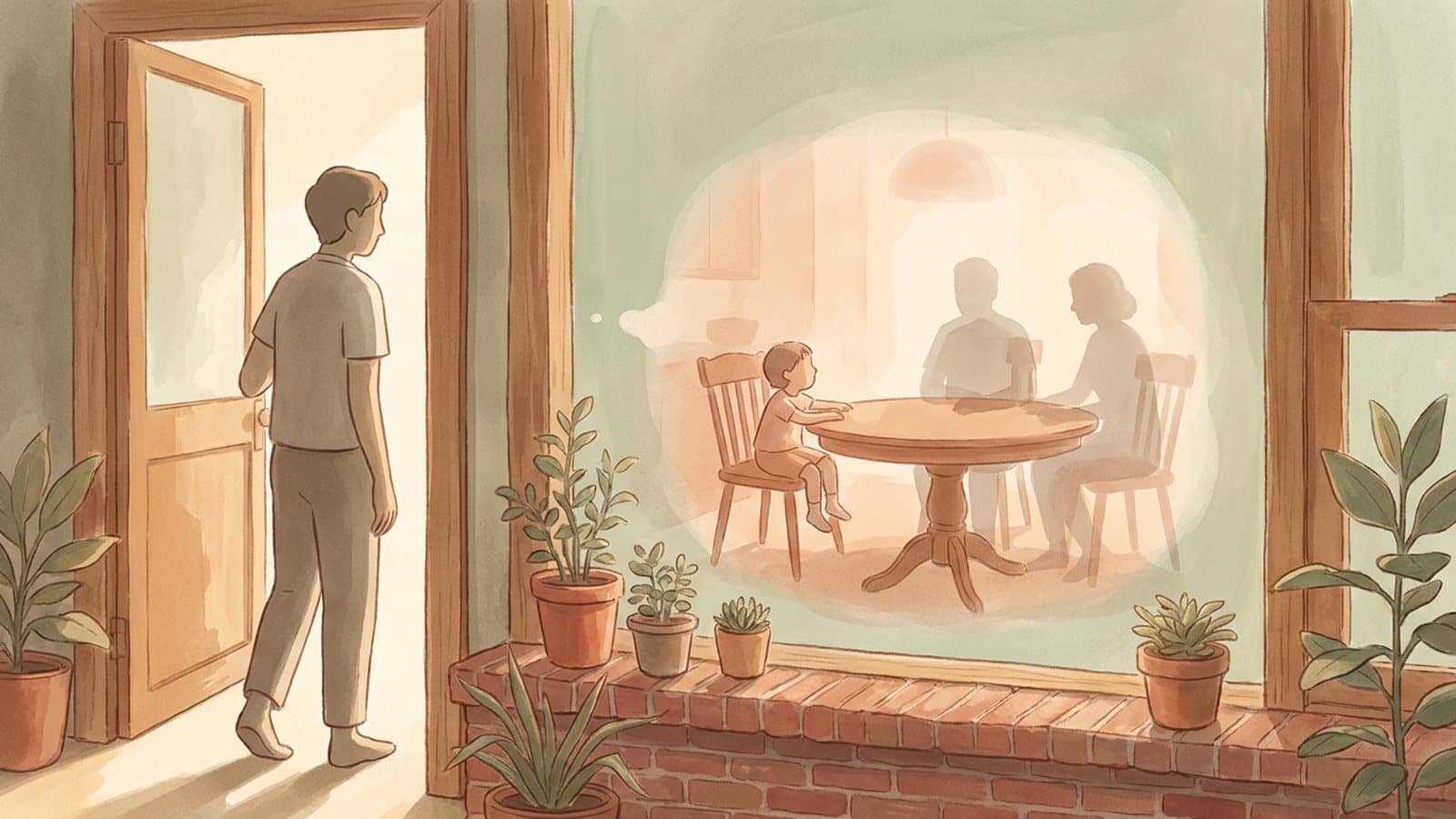
You get home for Lunar New Year, and within ten minutes an aunt says, "You've put on weight again." Suddenly you feel twelve years old. At work you handle plenty of difficult situations calmly, yet at home you flare up in seconds, or go quiet just as fast.
That "back home, back to being a kid" feeling is very common. "Family of origin" has become a popular phrase, especially in Taiwan, where 原生家庭 is talked about everywhere. It can genuinely help us understand ourselves, but stretched too far it becomes "I'm like this because of my family." This article looks for the middle ground: seeing the influence of family while trusting that you can still change.
What "family of origin" means: a starting point, not a fate
Your family of origin is the household you grew up in, usually your parents or main caregivers and any siblings. A systematic review of research on adolescent attachment and peer relationships (Delgado and colleagues) describes the family as our first group of belonging: it is where our first emotional bonds, values, beliefs and habits form. Research drawing on attachment theory has also found that a person's emotional history within the family is linked to their attachment style as an adult.
But "linked" is not "determined." The mainstream view in developmental psychology is that both inborn temperament and environment shape us, and the two are often hard to separate. Parenting matters, but it isn't the only factor: school, friends, work and all kinds of life experiences keep shaping us too.
A fairer way to put it: your family gave you your first "survival manual." It's influential, but it can be rewritten.
What home may have taught us
In a conversation with Dr Rangan Chatterjee, Nicole LePera, PhD, a US-trained clinical psychologist, makes a key point. Babies' nervous systems are immature; they can't soothe themselves and depend entirely on caregivers. When caregivers are stressed or not attuned, a child will choose to protect the connection over being their authentic self.
As adults, that choice can show up in several ways.
Pushing feelings down
If crying or getting angry led to scolding or coldness, a child learns that feelings are dangerous. Physician Gabor Maté argues that many children suppress anger, fear and grief because expressing them threatens their bond with stressed caregivers. Later this can look like not knowing what you feel, or always saying "I'm fine."
Playing a role
Some of us became the family peacemaker or the one who always came top of the class. LePera notes that people-pleasing and high achievement are often roles children adopt to keep the connection. They worked back then, but in adulthood they can make it hard to say no or to rest.
Reading everyone's mood
When someone nearby looks upset, you rush to cheer them up, fix it, or keep asking, "Are you angry with me?" LePera says many people learned in childhood to watch adults' emotions closely to stay safe, and came to read someone else's distress as "I did something wrong" or "I'm about to be left."
The harsh inner voice
A child can't safely conclude, "My parent is emotionally immature." It feels safer to decide, "Something is wrong with me," or "I'm only worth loving when I perform." In LePera's view, this becomes an inner critic and a strong sensitivity to other people's judgement.
Understanding is not blaming
Reading this, some memories may come up, along with anger or sadness. That's normal.
Psychiatrist Dr Alok Kanojia (Dr. K) points out that if you never let yourself admit where a parent fell short, the unresolved hurt and anger often turn inward as self-criticism. He isn't saying parents are villains. His point is that it's hard to truly let go of a harm that has never been acknowledged. Naming what a parent got wrong and remembering what they gave you can both be true.
Maté adds that a parent's misattunement usually comes from unresolved patterns passed down through generations, not deliberate intent. This isn't about excusing anyone; it gives you a fuller picture.
LePera is clear that making peace with the past doesn't mean approving of abuse, or staying in contact with someone who harms you. Acceptance doesn't cancel out the grief, anger and loss you may need to feel.
One more thing is worth keeping in mind: blaming everything on the past can also keep us stuck. The task is to tell apart real harm you went through, which deserves to be taken seriously, from old habits you no longer need, which are where you can start practising change.
What to practise as an adult
LePera has seen many people who understand their patterns perfectly yet keep repeating them. One reason is that familiar habits save the brain effort and feel predictable, so trying something new makes the body uneasy and pulls us back to the old way. That's why practice often needs to involve the body, not just the mind.
1. Check in with your body a few times a day
Set an alarm or sticky note as a reminder. Then check three things: muscles (clenched jaw, raised shoulders, braced stomach), breathing (shallow, fast or held), and heart rate. If you notice tension, slow your breath and soften your muscles before deciding how to respond. If sitting still with eyes closed makes you more anxious, focus instead on the warmth and taste of a cup of tea. See also: Breathing techniques for stress.
2. Four steps for family gatherings
Dr Tracey Marks explains that family can set us off so easily because of emotional memories formed early in life; being back in a familiar setting makes old reactions easier to call up. She suggests:
- Name the feeling: silently say, "I'm irritated," or "I feel criticised."
- Ground your body: breathe slowly and feel your feet on the floor.
- Reframe: "Maybe asking about my weight is the only way she knows to show she cares," without having to agree with it.
- Reflect afterwards: what went better than last time, and what would you adjust next time?
3. Let others have their own feelings
Next time someone is in a bad mood, try not to rush in to cheer them up, fix it or question them. LePera sees letting others feel what they feel as a step out of the "their mood is my fault" pattern.
4. Say your boundaries
A boundary isn't an attack; it's what lets a relationship last. Short, specific and early works far better than holding it in until you explode. If family often use guilt or threats to make you give in, read Emotional blackmail.
5. Change one thing at a time
LePera also warns that trying to overhaul your whole life at once overloads the system and makes it easier to fall back into old habits. Pick the smallest change, get comfortable with it, then add the next.
6. Build new support
Maté encourages honest, vulnerable conversations with trusted friends, and asking directly for help instead of carrying everything alone. Safe new relationships are themselves a place to learn new ways.
When you need more support
If childhood experiences keep affecting your sleep, work or close relationships, or certain memories are hard to settle, working through them with a professional can help a lot. In Taiwan you can see a counselling psychologist (諮商心理師) or clinical psychologist (臨床心理師), and if you also have ongoing sleeplessness or low mood, a psychiatrist (身心科 / 精神科). Start with Finding a psychologist in Taiwan, or read about attachment styles.
If you are experiencing, or have experienced, family violence, abuse or neglect, these Taiwan lines can help: call 113, the protection hotline (24 hours). If you feel very low or have thoughts of harming yourself, call 1925, the Taiwan Ministry of Health and Welfare's Mental Health Support Line (24 hours). In immediate danger, call 110 (police) or 119 (fire and ambulance).
Some of what you carried from home you'll want to keep, and some you'll want to set down. Being able to tell them apart is already a way of choosing your own path.
This content is health education and self-care information, not medical advice, diagnosis or treatment. If you are in danger, call the 1925 Mental Health Hotline (24 hours) or 119.