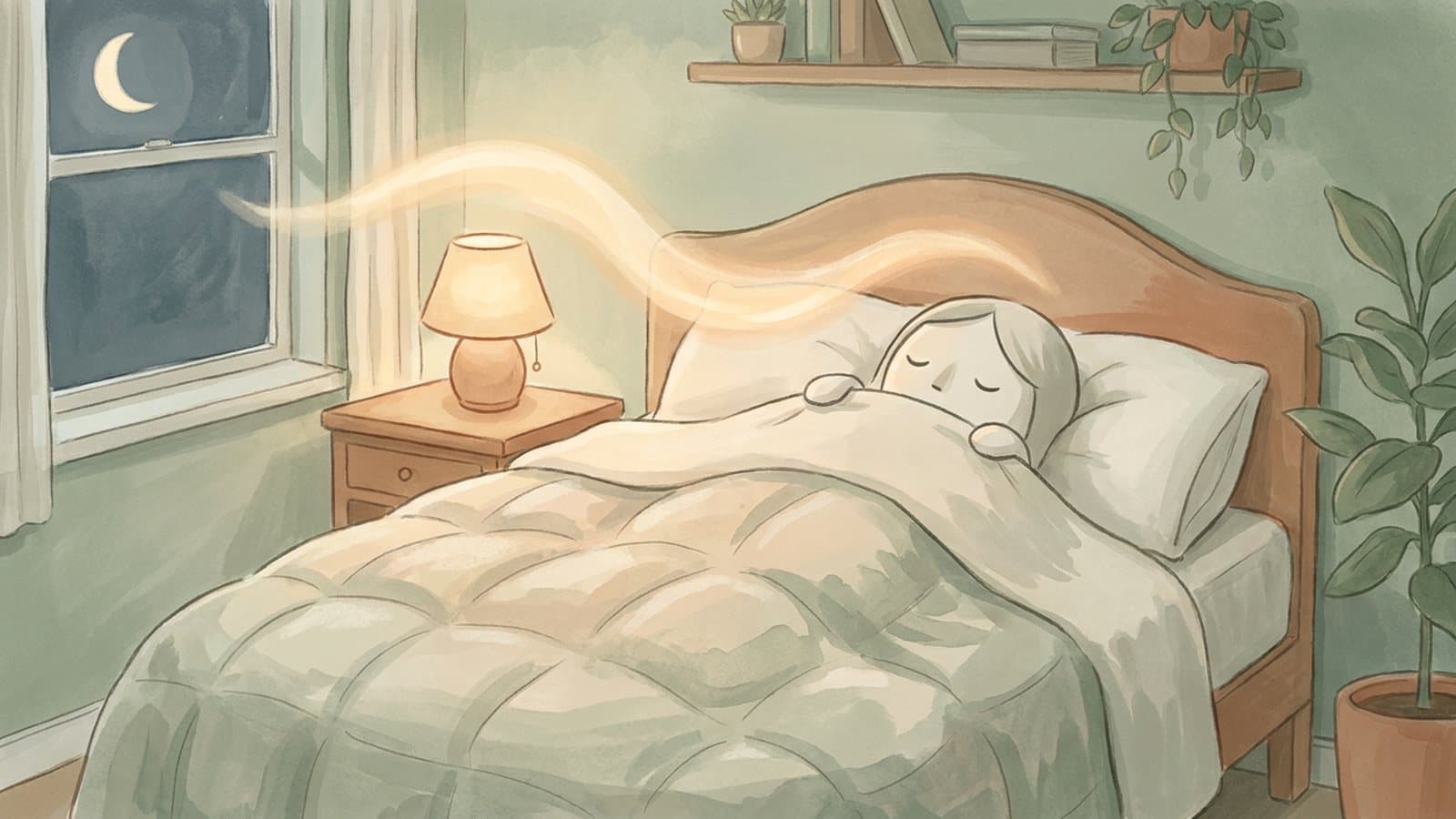
It's past midnight and you have an early start. You close your eyes and tell yourself to sleep now, and somehow your heartbeat gets louder while your mind replays the day's conversations.
If that sounds familiar, start here: not being able to sleep doesn't mean you've forgotten how. Often your body and brain are still running in daytime mode and need some help shifting down.
Why trying harder to sleep backfires
Sleep isn't something you can push your way into. Psychiatrist Tracey Marks describes two forces. Sleep drive builds steadily from the moment you wake up. Wake drive keeps you alert. You fall asleep when the first is strong enough and the second has quieted down.
The trouble is that when you lie in bed worrying, your brain treats those thoughts as threats to deal with. Stress hormones rise, your heart rate and body temperature go up, and the wake signals stay on. Your body, in Marks's description, is getting ready for a fight, not for rest.
Emma McAdam, drawing on cognitive behavioral models of insomnia, points to a second trap. When falling asleep becomes a test you have to pass, the pressure of "I need to sleep right now" makes your nervous system more alert, not less.
There's a third pattern too. After enough nights of tossing and turning, the brain can learn to link the bed itself with frustration. Marks explains this as conditioning, and it's why you can feel exhausted on the sofa and wide awake the moment you lie down.
So everything below has one aim. It isn't about forcing sleep. It's about lowering your level of alertness so sleepiness has room to arrive.
The hour before bed: let your brain power down
When NCCIH reviews research on insomnia, it treats bedtime relaxation as one part of a wider set of sleep habits, not a standalone fix. You don't need all of these at once. Pick one or two to start.
- Keep a regular schedule. Go to bed and get up at roughly the same times.
- Avoid stimulants late in the evening. Caffeine, nicotine, alcohol, large meals and hard exercise too close to bedtime can all make it harder to settle.
- Dim the lights and step away from screens. Bright light from TVs, computers and phones is on the list to avoid. Charging your phone outside the bedroom is a simple first move.
- Keep the bedroom quiet, cool and dark. On a humid summer night, adjust bedding or air conditioning until the temperature feels comfortable.
- Get outside during the day. NCCIH also suggests spending some time outdoors every day.
Leave your worries on paper, not in bed
If your sleeplessness is mostly a mind that won't stop, McAdam suggests a scheduled "worry time". In the afternoon or early evening, take about 15 minutes to write down everything circling in your head, then sort it into two groups:
- Things you can act on: write down the smallest next step, and when you'll do it.
- Things you can't solve right now: acknowledge that there's no answer tonight, and tell yourself it can wait.
She notes that this takes a few weeks of practice to settle in, so don't give up after one night.
Once you're in bed: relaxing the body and the breath
An honest note first: NCCIH says the evidence that relaxation on its own helps chronic insomnia is limited and of low quality. Relaxation is, however, often one component of cognitive behavioral therapy for insomnia (CBT-I), a psychological approach that remains the most strongly recommended option. So treat the practices below as bedtime self-care, not a guaranteed off switch.
Progressive muscle relaxation: let your body clock off first
Progressive muscle relaxation was first proposed by Jacobson in 1929. You tense and then release muscle groups in turn, in rhythm with your breath. A meta-analysis by Li and colleagues pooled 14 randomized controlled trials with 957 adults and found the practice was linked to better sleep quality. Note that the participants were all patients with some degree of illness (people with cancer and other patient groups), not healthy adults who simply sleep badly. The studies also varied a lot, and no clear benefit showed up in adults aged 55 and over, so results for the general population may differ.
Try it like this:
- Lie on your back. Breathe in naturally and make tight fists for a few seconds.
- As you breathe out, let go all at once. Pause and notice the warmth or heaviness in your hands.
- Move through your arms, shoulders, face, belly, thighs, calves and feet.
- Use about 70 to 80 percent effort when tensing, and skip any area that hurts.
Longer exhales: tell your body it's safe to rest
Several of the experts we drew on describe a longer out-breath as a way to help the body shift from tension toward rest. Marks describes the "4-7-8" breath designed by Dr. Andrew Weil, but stresses that there isn't good evidence this ratio works better than other slow-breathing patterns.
- Breathe in quietly through your nose for 4 seconds.
- Hold comfortably for 7 seconds.
- Breathe out slowly through your mouth for 8 seconds.
- Repeat for several rounds. Rest your attention on the counting, and bring it back when your mind wanders.
If holding your breath feels uncomfortable, shorten the pause. What matters is that the out-breath is longer than the in-breath. If you have asthma, COPD or another breathing condition, a heart or circulation condition, are pregnant, or tend to get dizzy while practising, skip the hold or check with your doctor first. Marks also notes that box breathing (in, hold, out, hold, four counts each) suits calm daytime alertness better, while longer exhales are a better fit at bedtime. For more options, see three breathing techniques for stress.
Relaxation practice is generally safe for healthy people, but NCCIH notes that a few people feel more anxious or get intrusive thoughts while doing it. If that happens, just stop.
Can't sleep: get up or stay in bed?
It sounds backwards, but a lot of sleep-education advice says that if you can't sleep, get out of bed for a while. The point is to stop your brain linking the bed with lying awake.
- Don't check the clock. Working out how many hours are left only raises anxiety.
- If you're still wide awake after about 20 minutes, get up. No need to time it; a rough sense is enough.
- Go somewhere dim and do something quiet, like reading a paper book. McAdam also suggests writing your thoughts on paper without trying to solve them, setting the page aside, and telling yourself you'll look at it in tomorrow's worry time.
- Avoid screens. Scrolling at this point tends to wake you up further.
- Go back to bed when you actually feel sleepy.
It can also help to reframe the time in bed. It isn't a sleep exam. It's a chance to let your body rest, and letting go of "I have to fall asleep" sometimes lets sleepiness return sooner. If anxiety shows up in your days too, see what to do when you feel anxious.
When to get professional help
A bad night or two is common. It's worth talking to a doctor if:
- You regularly take more than 30 minutes to fall asleep, wake up and struggle to get back to sleep, or wake too early. Marks suggests getting checked if this happens at least three nights a week for three months or more and affects your days.
- You often feel sleepy during the day, nap a lot, or fall asleep at the wrong times.
- A bed partner says you snore loudly, choke, gasp, or seem to stop breathing.
- You get creeping or tingling feelings in your legs or arms in the evening or at bedtime that ease when you move.
These signs come from MedlinePlus's guide to sleep disorders. Sleep problems have many possible causes, and a doctor can assess what's going on and arrange a sleep study if needed. In Taiwan you could start with family medicine, psychiatry, or a sleep clinic. If you'd like to learn approaches such as CBT-I, a clinical psychologist can help. Keeping a sleep diary for a week or two before the appointment helps: note when you go to bed, when you wake, naps, and caffeine. For questions about medication or sleep aids, talk to your doctor.
If heavy emotions sit underneath the sleeplessness, or you have thoughts of harming yourself, please don't carry it alone. In Taiwan, you can call the 1925 Mental Health Hotline (24 hours). In an emergency in Taiwan, call 110 or 119.
If sleep still doesn't come tonight, that's okay. You don't have to get this right the first time. Give your body some room, and take it slowly.
This content is health education and self-care information, not medical advice, diagnosis or treatment. If you are in danger, call the 1925 Mental Health Hotline (24 hours) or 119.