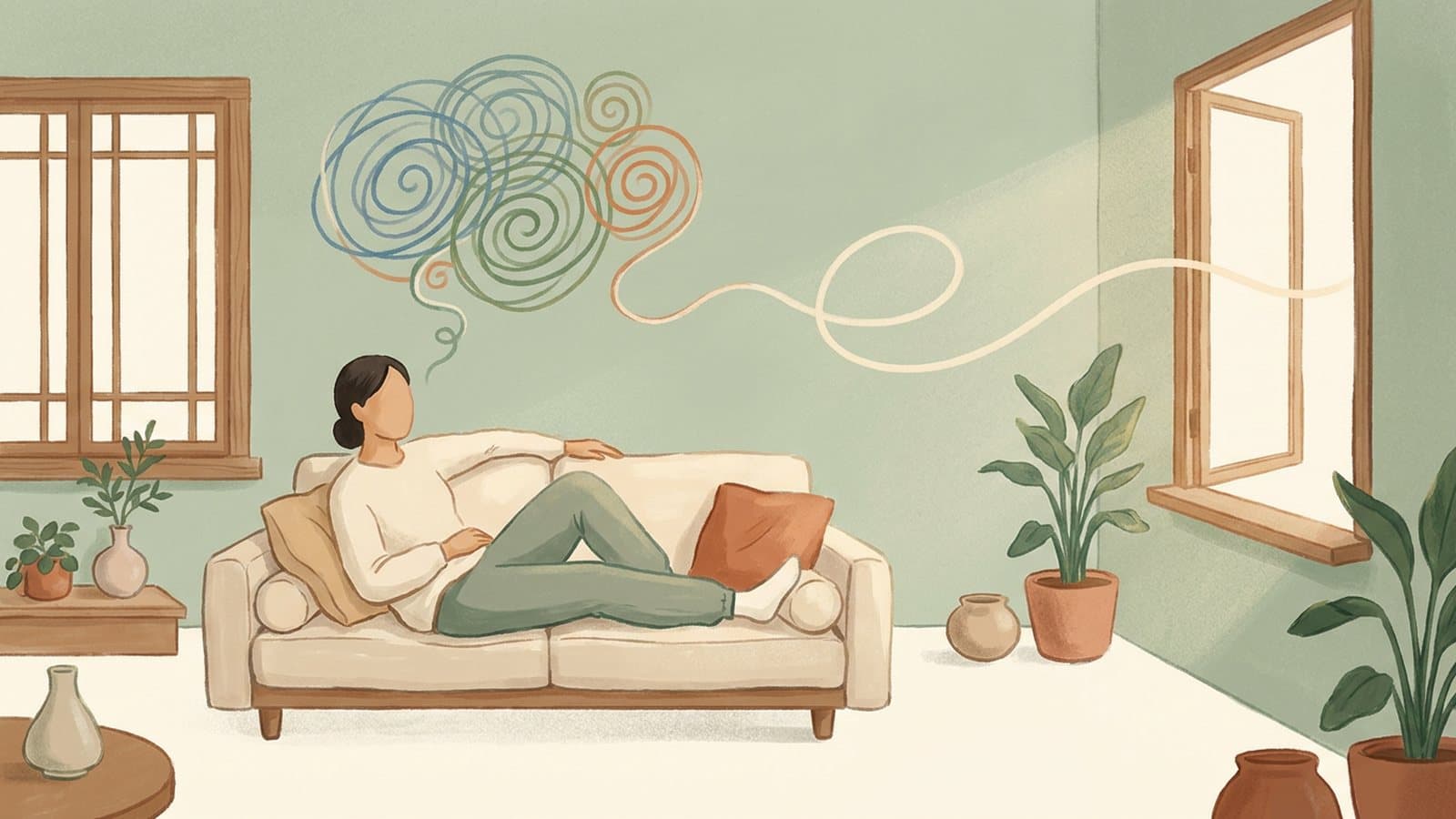
You're lying in bed and something you said earlier pops up: "Should I not have said that?" Then: "Will they dislike me now?" "What if I mess this up?" An hour later nothing is solved, and you're more tired than before.
Overthinking doesn't mean you're foolish or weak. Often the brain is simply stuck in a loop it can't exit. This article explains how that loop works and offers five things to try; pick one or two at a time.
How rumination differs from problem solving
Psychology research calls this kind of thinking "repetitive negative thinking": thinking that is repetitive, passive, fairly uncontrollable and focused on negative content. It has two familiar forms:
- Rumination: repeatedly focusing on your negative feelings and their causes, meanings and consequences. It usually looks backwards: "Why did this happen?" "Am I a terrible person?"
- Worry: a future-facing chain of negative imaginings, a mental attempt to solve problems that is hard to switch off.
Researchers used to study the two separately, but later studies found a shared factor underneath, and today they are seen as largely overlapping.
So how is it different from thinking hard about something? A useful framing from Tracey Marks's YouTube channel: problem solving has a beginning, middle and resolution and leads to action; overthinking is an open-ended loop driven by fear that leaves you drained and stuck.
Alok Kanojia (Dr. K) adds that people often mistake rumination for deep thinking or insight. Analytical people in particular can build theories that sound coherent but actually make them less willing to act.
Why the more you think, the harder it is to stop
It becomes a habit
A systematic review (Li and colleagues) describes rumination as a mental habit. When goals go unmet and mood drops, people analyse why, over and over; repeated often enough, low mood itself can trigger rumination automatically, and the loop keeps running even after the original problem is solved or let go.
That helps explain why arguing with your thoughts often isn't enough. Habits run on a cue-response link; changing them tends to work better by spotting the cues and practising a different response.
It makes problems big and abstract
The same review notes that unhelpful repetitive thinking tends to be abstract and evaluative, interpreting what events mean, whereas constructive thinking is specific, concrete and action-oriented. Dr. K describes something similar: rumination squeezes a specific event into an abstract verdict like "I'm a failure," deepening pessimism and making small steps feel pointless.
Suppressing it makes it come back
On the Therapy in a Nutshell channel, Emma McAdam explains that ordering yourself to stop thinking about something tends to backfire. The brain believes worry helps prevent bad outcomes, so it doesn't stop on command.
Research also links repetitive negative thinking to the onset and persistence of depression and anxiety. So it isn't "just overthinking"; it deserves care.
Give worry a fixed time
Practice 1: schedule a worry slot
Emma McAdam recommends this practice. The aim isn't to ban worry but to give it a set place:
- Pick the same time and place each day, for 15 to 30 minutes.
- Avoid just after waking or just before bed, and don't do it in bed or other places you relax.
- When the time comes, write every worry on paper to make it concrete.
- When the timer ends, get up, leave the paper behind and switch to something engaging, like a walk or calling a friend.
- When worries pop up during the day, acknowledge them, tell them to wait for worry time, and return to what you were doing.
McAdam suggests practising daily for at least three to four weeks. Note that this is an everyday practice, not a tool for the middle of a panic attack, and its purpose is to contain rumination, not to analyse endlessly within the slot.
Practice 2: turn thinking into time-limited problem solving
If part of the worry really is something you can act on, Tracey Marks suggests a problem-solving block of about 20 minutes. If you haven't finished when time is up, jot down your progress and ideas, step away to rest your mind, and come back in another planned session.
Dr. K adds: don't try to solve complex life problems while you're very worked up. Settle your body first, then break the big problem into small, concrete actions, even if one step on its own seems too small.